Showing posts with label Honey Bees. Show all posts

Wednesday, October 23, 2013

News from the Homestead

I haven't sent an update to my Kickstarter followers in awhile.  As I interact in the community, surfing, going to events, it's amazing how often people ask me how things are going with the beehives or with the chickens.  It's like another unexpected effect, the parade of families or folks walking dogs who make it part of their journey to give the chickens a visit.  I see children talking to the chickens every day!  So to my community of readers on the internet...whomever you may be...here's the update.
Topbar Hive inspection with friends from the Bee Society
The bees have proven to be a complicated and slow endeavor with much wonder and exploration but very little honey.  You can catch up on my bee chronicles by reading this post and this post and this post and this post and this post.  Where we stand today is total loss of Hive #1.  It has been dismantled and awaits a new colony next Spring.  Hive #2, the topbar hive, is thriving.  The bees have built out several new frames of comb and the Queen is busy laying eggs.  There doesn't seem to be a lot of honey, so I haven't harvested any comb and have basically left this hive untouched.  My plan is to give these bees this first season to establish themselves and then next year I'll probably be able to harvest honey twice, once early in the season and a second time towards the end of the season.  There is a little bit of a mothy, sticky insect laying eggs with little white worm larvae.  I am encountering them in the spaces between the wooden bars, the area where the bees fill in with propolis.  I seem to split the little larvae's bodies open when I use my hive tool to pry the bars apart.  But it is so far only a minor infestation and I have left the bees to deal with the problem themselves.  This weekend I will be getting some much needed training.  A topbar hive specialist, Les Crowder is coming to San Diego to offer a two day workshop for members of the San Diego Bee Society.  So I will spend the weekend immersed in all things bee and I will have a lot more to say about my own hive next week after an inspection with all my new bee knowledge.

The chickens are doing great.  With the weather getting colder and the days shorter two ladies have stopped laying eggs, but two are laying daily.  My babies have grown up so much.  They are almost 5 months old and so far it looks like they will both be keepers, I think they are both hens and not roosters.
Here's my Yellow Baby
And here's my Grey Baby


Eating fresh grass makes for deep yellow yolks rich in beta carotene.

Goldie is joining in the Fall Spirit with some pumpkin scraps.

A proud mom with her best egg layer, Goldie!

Thursday, July 4, 2013

Amazing things I've learned recently about Queen Bees

The Queen's body is twice the length of the worker bees and with a tapered point.
In a colony of bees, only the Queen can lay eggs that will become females, that is, future worker bees and future queens.  The worker bees can also lay eggs, but they are unfertilized and that makes them males, or drones, which have only a small function in the survival of the colony.  When the colony wishes to raise new queens, they form a special droplet shape form of honey comb and they feed the larvae there royal jelly, a substance worker bees secrete from a gland on their head.  The queen is fed this royal jelly directly to her mouth throughout her life, it is all that she eats.  Regular bee larvae are fed a diet of honey and pollen known as bee bread.  In Southern California wild bees are Africanzied, the so called killer bees.  They are more aggressive than european honey bees.  Capturing a wild hive, rescuing it from an undesirable place on someone's property, is a great way to support the bees in this time of crisis for bee populations.  But a rescued colony of bees should be re-queened to help calm there genetic disposition. If you replace an African Queen  with a European Queen, in about a month the genetics of the entire colony will be transformed!  You order a Queen from a bee breeder, in the Spring you can go ahead and order a whole colony of bees, thousands of bees and a queen, or you can just order a queen who is shipped in a tiny cage with a few attendant bees who feed her and keep her alive.  They are kept in their cage with a candy or sugar plug that they slowly eat.  Replacing the Queen isn't easy, you can't just drop her in the hive, they won't recognize her and they will kill her.  First you must find the existing Queen and execute her.  Finding the Queen is like playing a very complicated game of Where's Waldo, but in this game you have to wear lots of heavy clothes and all of the Waldo's can sting you!  It has recently taken me three hive inspections to finally discover my queen, pull her out, and give her the royal smoosh.  Once you have eliminated the queen, you leave the hive without a queen.  The bees will begin to detect her absence, they will know that there is no longer a Queen I they will try to raise a Queen by feeding royal jelly to some of the larvae.  After a few days you place the new queen in to the hive, but still in her cage.  The bees will begin to smell her pheromones and after a few days of eating at the sugar plug, it will open up and she will be released from her cage.  Hopefully they have grown accustom to her scent and will accept her as they know they are in need of a Queen.  You must manage there possible creation of new Queen cells, pinching them off and discarding them.  If new Africanized Queens emerge, they will probably kill the new queen.  In a half hour I will drop my queen into her new hive and say a prayer for her success and survival.  My Queen has been neglected, it has been so difficult for me to find the feral queen that my poor European Queen has been in her cage a week.  She is still alive with one attendant, but the other attendants are in a pile on the bottom of the cage, dead.
Work is made easier with new gloves and a frame gripping tool
A happy comb!
Placing the Queen cage in the comb, this work also made easier with new technology, a rack made of cinder blocks
The beeswax easily holds on to the plastic cage
Replacing the top bars, I numbered them so I won't make a mistake
Smoking the bees as I press the bars together so as not to squish any bees
Well I opened the hive, so much brood cell!  A drastic difference from what I have been seeing in my other hive.  I didn't see any queen cells forming yet.  I installed the Queen in the middle of the hive in comb with lots of brood cells.  I reunited with an old friend from high school and he got some photos as well as a video in which I am so excited by what I see I am basically at a loss for words.

In 2 or 3 days I'll open the hive again and see if the Queen has been released from her cage.

Blessings tos the Queen, may she be healthy and vital for many moons.

Wednesday, June 26, 2013

Updates and Chores

It's been two weeks since I've written anything (I've been busy posting at my new blog paraguay1994).  I am deeply in my routine of country chores.  So many things to do daily and weekly to keep it all clean and productive.
Mom says, look what I've got here!
She does a great job making sure the chicks eat lots.
The baby chicks are an amazing joy in my life.  At about 4 days old their little wing buds began to shoot out and now they have beautiful little wings.  I don't think they will be feathered like the mom, a silkie.  I think they will have standard feathers.  But they do have feathered legs and feet like their mom.  Yesterday I noticed a little tail pop out on both chickies just like the wings had sprouted.  I've named them Cloudy and Yellow.
This is Yellow. 
This is Cloudy.
Notice the little tail that has sprouted!
The honey bees have a new vertical garden to give them more protection and environment.  I planted them with seeds of morning glory and spinach as well as small strawberry and marigold plants.  The spinach hasn't sprouted, but everything else is growing well in their small pallet spaces.
A vertical garden made with pallets, screening, staple gun, compost and plants


Morning Glory sprouts
Sunrise on the apiary.
The first hive continues to struggle.  I opened it two days ago and I was confused by what I saw, a queen, but no pink marking...what happened to my new queen?  and who is the queen I spotted?  And most importantly, where is the brood cells?  I would characterize this hive as sick and unproductive.

The second hive gave me a good scare two weeks back.  I made several mistakes.  First mistake, I treated the hive influenced by my experience with hive #1 instead of giving the hive the proper respect and assessment that each hive must be given.  I wore some gloves that have been fine working with #1 because I couldn't find the proper leather gloves I have been using.  These gloves have a rubber palm with some stretchy knit material on the backs of the hands.  Second mistake, I didn't have proper fuel for the smoker and I did not use the smoker effectively to calm the bees.  When getting several frames in to my top bar hive inspection, moving and lifting bars of comb and bees, the bees began to sting my knuckles and tops of my hands through the gloves.  It happened very quickly, in just a few seconds.  Maybe 5-10 stings, 4 on one finger!  My hands swelled up like sausages for two days and I moped around, drugged up on antihistamines.  It has definitely given me pause to think about bee tending as a hobby.  I am going to keep with it for now, but my respect has grown.  When I revisited hive #2 this week I wore my wetsuit with my overalls on top, boots, veil, leather gloves, duct tape seams.  I collected dried pine needles and got a good smoke from the smoker.  Everything went well and the hive looks healthy.  I didn't spot the queen, but I did see larvae and have been observing the collection of pollen by foragers which is a sign of the feeding of brood.

Potential...
My vegetable garden is finally showing some success.  I finished a second batch of compost and added that soil to my raised bed and mixed it in with straw.  I planted seeds of lettuce and arugula.  I couldn't keep my chickens out of that wonderland, and had them confined in there coop for a week until we finished a chicken wire fence surrounding the bed to protect it from their scratches and pecks.

Swiss Chard protected from curious chickens.
Land prepped with fresh compost and straw.
Lettuce sprouts...and ficus berries.
Lettuce growing...enough for harvest!

Saturday, June 1, 2013

Neighborhood Hive Rescue

I was just lamenting the the lack of photos of my bee tending, this hive rescue included a photographer, thanks Penny!
Prepping the equipment before opening the hive, I'll use rubber bands to hold the comb in place.
I got a phone call yesterday from a neighbor just up the hill from me, she has a blog too, so here's her story chapter 1, chapter two and chapter three.  There was a hive of bees located in the water meter box in the sidewalk just in front of her home.  Technically it was the city's problem, and she had called and let them know.  She didn't really want them to deal with the issue though as she figured they would use poison and annihilation and not salvage and relocation.  I wasn't sure if I could help, but I went ahead and purchased supplies for a new bee hive, visiting a Del Mar supplier for the first time, Knorr Candle Shop.  
Wow, look what I found!  And there is two more big combs attached to the underside of the water meter.
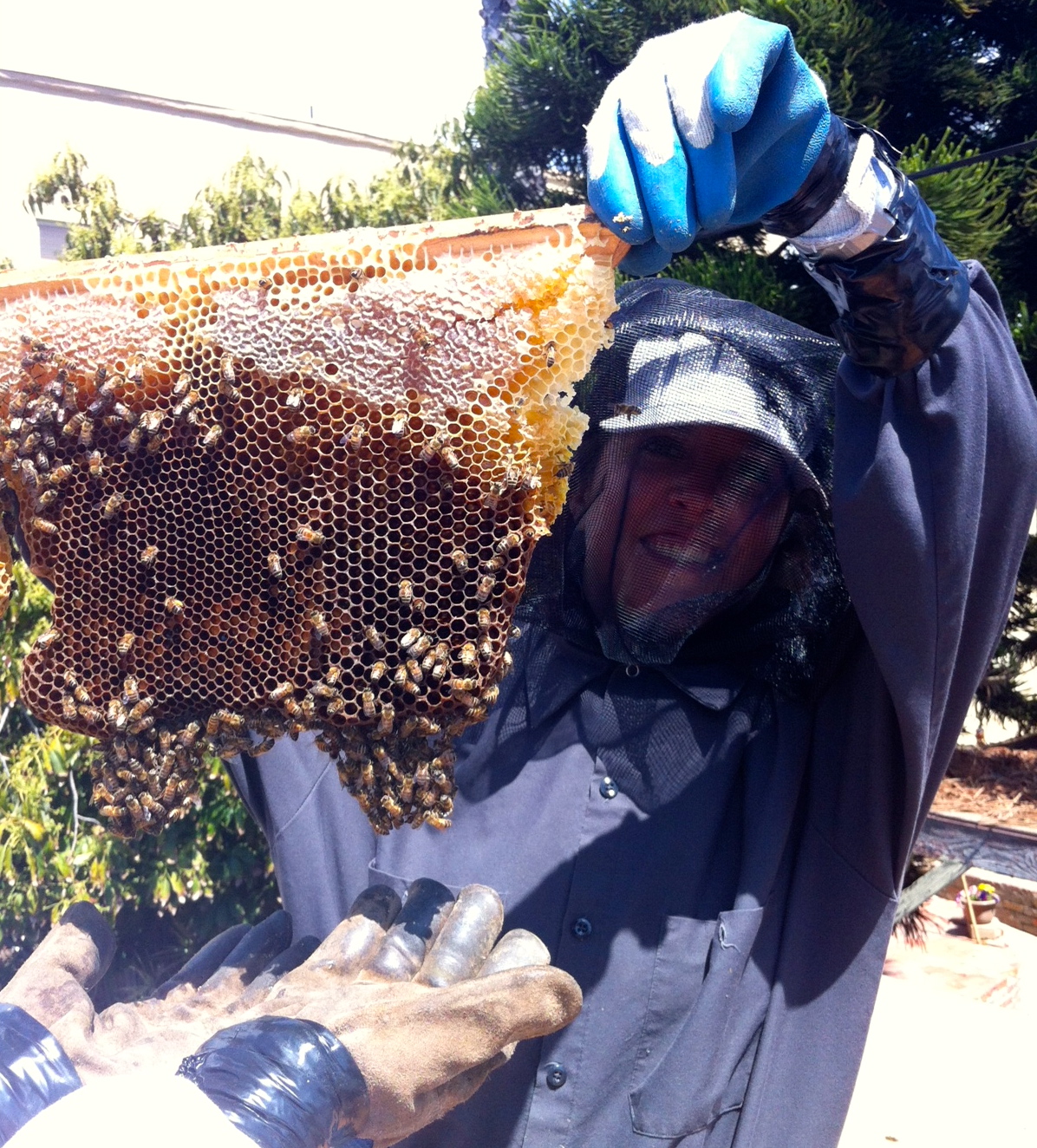
Love this photo, I got so dirty, honey dripping everywhere.  I could barely finish the job my gloves were covered in honey!
In the late afternoon I headed up to her house with the new hive and all my tools.  We talked for awhile and then I suited up, lit up the smoker, and pulled up the cover on the water meter box.  There was a big hive inside, lots of bees and lots of space for them to create deep comb.  The biggest combs were probably 20 inches long and 15 inches deep.  There was about 6 big combs packed with honey, brood and pollen.  I had much more success than when I cut out and placed into frames my first hive.  I figured out to flip things upside down and use gravity to help me settle comb with a good edge along the top of each frame.  It made me feel bad to cut apart the comb, causing so much destruction.  There was honey dripping everywhere and little baby bees who would never get their chance to fly.  A little destruction for the preservation of the colony, I'm sure the bees were willing to make that sacrifice.  When I finished, there were still a lot of bees inside the water meter and lots of aggravated bees in the air all around me.  I wasn't sure if they would all choose to fly into their new home or decide to do something else entirely!

The big comb fit well into the frames, but I would have to discard sections which is sad.

Look at the honey all over the curb dripping out of the comb.
The bees beginning to congregate with their comb in their new home.
The job almost done, you can see the discarded comb in the left corner.
The lid to the water meter with all of the comb removed.
I went back after sunset and it was a success!  Most of the bees had entered the hive and there was just two small clumps of bees still hanging out in the water meter box.  I decided to give them the night to collect themselves and will return tomorrow night to collect the hive and move it to a new location, maybe an expansion to my own apiary, maybe somewhere else.  
After sunset I returned and was happy to find the water meter mostly empty and the bees congregating at the entrance to the new hive.

Removing the hive and refitting it into the box was an experience that went soooo well!  I had never done a complete hive rescue before, although I did get some experience cutting out comb and placing it into frames with my first hive.  When I went to my neighbor's house I was imagining what I would find and how I would deal with it, and what I encountered was exactly what I imagined.  I thought my mind power was super awesome and I was pretty much thinking I was an expert bee keeper already!

Now, rescuing the hive, cutting it from its location and placing it into a hive box, this is work to be done in the day.  Most work with a bee hive is done during the day, when the foraging bees are off collecting nectar and the population of the hive is not all present.  When you work with the bees during the day you use smoke, blowing the smoke into the hive.  The bees react to this smoke with an emergency preparation technique, they begin to eat lots of honey.  They are preparing themselves for a possible evacuation and want to take as much honey along with them as possible in their bellies.  Eating the honey makes them sedated, kind of drunk, and you can open the hive and interfere with them and they won't begin an aggressive attack.

When moving a hive you work at night when all of the forager bees have returned to the hive and the complete population of the colony is present, calmly "sleeping" inside of the box.  My husband and I have moved two hives in the last two months, and both times we would arrive just after sunset, not wearing any protective gear, block off the entrance to the hive, quietly carry it to the car, drive it quietly but quickly home, place it in its new location, open the entrance and go to bed!

After moving this feral hive into its new home on a Friday afternoon, we decided to let it rest a day as the bees were still all over the place, gradually congregating in their new home.  On Saturday night we went to check it out, and there was a grouping of bees on the outside of the box at and above the entrance.  Maybe 200 bees, a small percentage of the hive, but too many to deal with.  We were able to bungie cord the box to secure its separate pieces.  Then I attempted to sweep them away and close up the entrance, but there were just too many bees flying in the air.  One stung my husband who then woke up a few hours later with allergy hives on his body.  He saw the doctor, and is doing fine, but now I've still got this hive to figure out and I've lost my second pair of arms!

I added empty frames of foundation to the hive to give the enormous population something to work with.
You can see the empty frames of wax foundation to my right, I am sliding the comb over to make space for the frames.
The next night I go back alone, I've talked to someone from the bee club and they teach me about spraying bees with sugar.  He recommends I make a solution of half sugar and half water.  You spray this solution on the bees and they clump together and become very sedate, licking the sugar off of each others bodies.  He called it a bee valium...sounds more like ecstasy!  He said it was important to collect this clump of bees as the queen might be there, waiting at the entrance, deciding whether to swarm and leave this new home she's been forced into.  So I sprayed the bees and swept them into a small box.  But I hadn't properly sealed the entrance and more bees were beginning to pour out, bees who had not received a dosage of sugar water.  After a few seconds of that madness I left the scene.  I went back again the next night and had a big plastic bag to draw around the entire hive, I had also better placed the stick over the entrance that day, sealing it with tape and only a one inch entrance.  I sedated the bees with the sugar, moved them out of the way of the opening and sealed the last inch with duct tape.  I chose not to sweep the bees, only sedate them and leave them clinging to the box.  I then wrapped the bag around the box and closed it with a rubber band.  There was a hole in the top of the bag, ripped by the bungie cords while pulling the bag on, and bees were getting a little angry, but I had my gear on and was trying to move fast.  I picked up the box and started walking to my open car, I made it about 8 of the ten feet and the bagged box just began to slip from my gloved hands (did I mention I had been stung on the hands a few times through my gloves?!?).  I fell to my knees, slowing the drop to the ground.  But it hit, and the three sections shifted and the bees began to buzz.  Holy shit, I thought, what have I done?!?  Couldn't walk away from that.  I said a word or two to myself then picked up the hive and got her back to the sidewalk.  I began ripping at the bag to free the angry bees.  And then I dropped to my knees again, working at the box to get its separate three pieces, bottom, frame box and cover realigned.  t was difficult with the tension from the bungee cords.  Once it was set, I walked fifteen feet away and waited till most of the angry bees had finished dive bombing my head before I jumped in my car and drove home.  I sat in my garden with my veil and gloves on in the cool evening.  Everything quiet around me, being sure that no more angry warriors were waiting in the folds of my shirt.  I sent out a message on-line to the bee club, offering up the hive to a helper.  It is too big of a job for this lonely bee keeper...I may still be able to get that hive home and keep her, but I'll need to find someone strong to help me get it into my car, and more difficult, up onto my roof.

I came home feeling like a failure, a liability to the neighborhood.  But my husband boosted me up, remarked on how well I learned important lessons with each attempt, adapting my technique and tools to my lessons.  I just like to be successful, and its difficult sometimes to ask for help.  So, dear reader, have a little honey in your tea today and offer up a prayer or a positive thought towards me and this hive rescue.

This story is to be continued...

Tonight is the night, I will be successful moving this rescued feral hive.  She will be placed effortlessly upon my roof and will be hive #3, a special hive because she is populated with local bees.  A friend is coming over, the blond version of myself.  She is a broad shouldered surfing massage therapist with a taste for adventure.  After reading the above links I have come up with a plan to smoke the bees, which I have not yet experienced during a hive move.  I also learned a great technique to properly close the entrance with the aid of a folded strip of metal screen.  I'll cover the metal ends of the bungee cord to prevent tears to the plastic bag I will use to seal up the hive for transport.

Stay tuned...

Hurray!  I've found some help and a new home for these bees.  I wanted to keep them just because the hive looked so big and healthy, but really the two hives I already have is plenty for me.  So I am happy to report that I have found an aspiring bee keeper with lots of property in Jamul who is elated to receive this hive.  I am grateful to find a good home for these bees, I am grateful this experience is almost over, and I am grateful for the challenge and all it has taught me.

The hive packed up in the truck for the ride to Jamul.
I was rewarded by my work today with this lovely text "Robin thanks again for the hive.  He is so excited.  He has been out most of the morning watching his bees.  He is going to the society meeting Monday so you have helped to create a new beekeeper."


Tuesday, May 28, 2013

Hive Number Two

Lighting the smoker to calm the bees.
Beekeeping seems to require two hands, and often you're wearing gloves.  The smoker makes things a bit grimy, and of course what's stickier than honey and propolis?  So I haven't been very good with bee photographs.  But here's a bunch of text about my beehives and a couple photos you might have seen before...

Bee Hive Number One: Carlota soon to be overthrown by Maximiliana

Bee Hive Number Two: Adelaide

Do to the generosity of others I began my beekeeping adventure earlier than expected.  Felipe, a friend of a friend, gave me a hive about 7 weeks ago.  I don't think it's doing well, it seems to be without a queen.  I see bees collecting honey and pollen, but I don't see brood, honeycomb cells filled with baby bees.  I went out of town and checked just before leaving and the hive looked great and I though I saw the Queen.  Two weeks later something had happened and now the hive is in limbo, it is not growing in size but it is also not disappearing.  There is also the possibility that I am wrong and I am hoping I can get someone more experienced to come look at my hives with me.  Good news is that I have ordered a new queen in a group order from the local bee club I have joined.  She arrives on Thursday.

A bee feasting on the nectar of a newly blossomed wild cactus flower.
In the meantime I have begun to look for bees to inhabit my topbar hive.  I have been looking for opportunities in the bee club on-line forum and I have been looking a little bit on craiglist in the same way that I looked for the now seven chickens I have purchased since January!  I came across a post last week for free bees in topbar hive traps, just what I needed!  I drove out with my husband at dusk on Memorial Day, stopping on the way for some Indian Food that had been recommended to me by a student.  The home was on a low ridge top and dense with a secret garden much like my mom's, but bigger.  Roses, lilies, flowers everywhere!  And birdhouses, handmade, painted, unique, different sizes, hundreds of them!  It was amazing.  Hidden in plain sight among the birdouses were swarm traps.  The home lay between different agricultural areas, orchards, and with the 2 acre garden the bees just love to show up to his property.  He had three top bar hives he showed us, beautifully made by hand, located in a clearing under some bigger trees.

The trap he chose for me was located on a low lying roof of an outer building.  He climber up a ladder and closed the door and handed the hive down to Tim who carried it to the car.  We placed it in the trunk, covered it lightly in a sheet, secured it so it wouldn't roll over, and took the fast lane home.  At home we locked up the dogs and carried the trap up to its location on the roof.  When we opened the door there was a loud buzz and a bunch of bees came out and we scampered down into the house and shut the door behind us!
Topbar hives allow bees to build there waxcomb in a more natural way than standard box hives.
The next day at noon when the sun had come out I smoked the trap and transferred the 8 topbars from the trap into my topbar hive.  I left three empty bars at the front of the hive to promote the creation of brood comb at the front of the hive, I then put the eight bars in order from front to back with three more empty bars behind and then the false wall.  There was only room behind the false wall for about 5 bars and I could see that the other guys topbar hives were several inches longer, maybe 6 more bars.

Well if you've made it through this far, thank you so much and let me know if you have any questions or if you are a neighbor and would like to participate in a hive inspection.

A favorite flower of the bee and its namesake, the hummingbird sage.

Tuesday, April 30, 2013

Honey Bees at Esalen


Here is another story through pictures of my recent stay to Esalen.  Words to follow soon, but for now simply enjoy the images.